Nick Pallavicini

I build AI systems for the people who run the work, and take them to production.

Eight years in early-stage go-to-market, and for the last six months a builder: ten products designed, shipped, tested and deployed on my own, most of them used by real people. Before tech I was an EMT and spent years at a building supply yard, which is why I know where operations projects actually break.

Looking for A role where I sit with the customer, find the real constraint, build the fix and stay on it until it's used. AI strategist, forward deployed, founding GTM engineer.

Based Danville, California. SF hybrid and travel are fine.

Work

Newest first. Counts come from the repositories as of November 3, 2026. The current company is an early-stage agent platform that I don't name here.

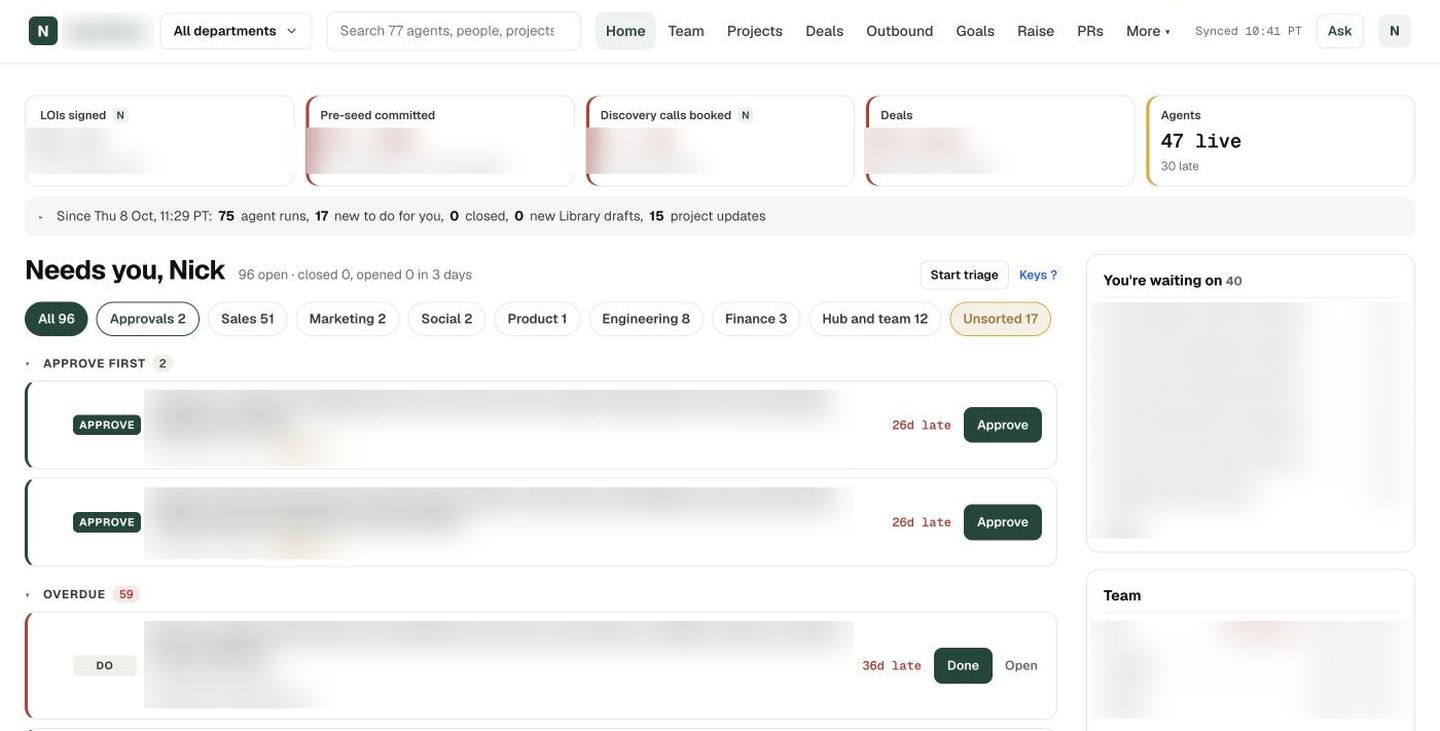
The GTM hub's home page

The hub's home page. Account names, fundraising numbers and teammates are blurred.

GTM hub and demo engine

The operating system an agent startup runs on, and a demo engine that builds a working prospect demo in minutes.

I joined to sell, and ended up building the system the company runs on: a hub with its own agent over about 190 files of pipeline, account plans, battlecards and playbook, with 24 scheduled agents (inbox drafter, follow-through, investor desk, PR tracker) and hourly email and Slack checks.

The demo engine is what prospects notice. Give it a brief and it builds a fictional company's own system with an assistant inside that acts as whoever is signed in, on top of 13 base demos I built for HR, MSPs, restaurants, mortgage, payroll and leave. A tester agent runs up to 14 scripted passes against every build before a person sees it.
When
Sep to Oct 2026
Role
Designed and built solo
Stack
Cloudflare Workers, Durable Objects, the platform's SDK, Claude
Pipeline
Local, staging with real agents, production
Proof
23 demo builds; tester agent, up to 14 passes each
Status
Hub live; scheduled agents paused since Oct

Bend and Build

A training and nutrition coach I use every day, so it's the product I'm hardest on.

Log a meal from a photo or a sentence. It tracks every nutrient, tells you which ones you keep missing, adjusts the program, and reads the scale and your pantry from pictures. SMS coaching, an admin dashboard for support, and its own Claude connector so a coach can read and write the app's data without touching the database.

When
Oct 2026
Role
Own product
Stack
Cloudflare Workers, D1, Anthropic API, Twilio, MCP
Pipeline
Local, a separate test account, production
Proof
Every model call metered; last deploy Nov 2
Status
Live, daily use
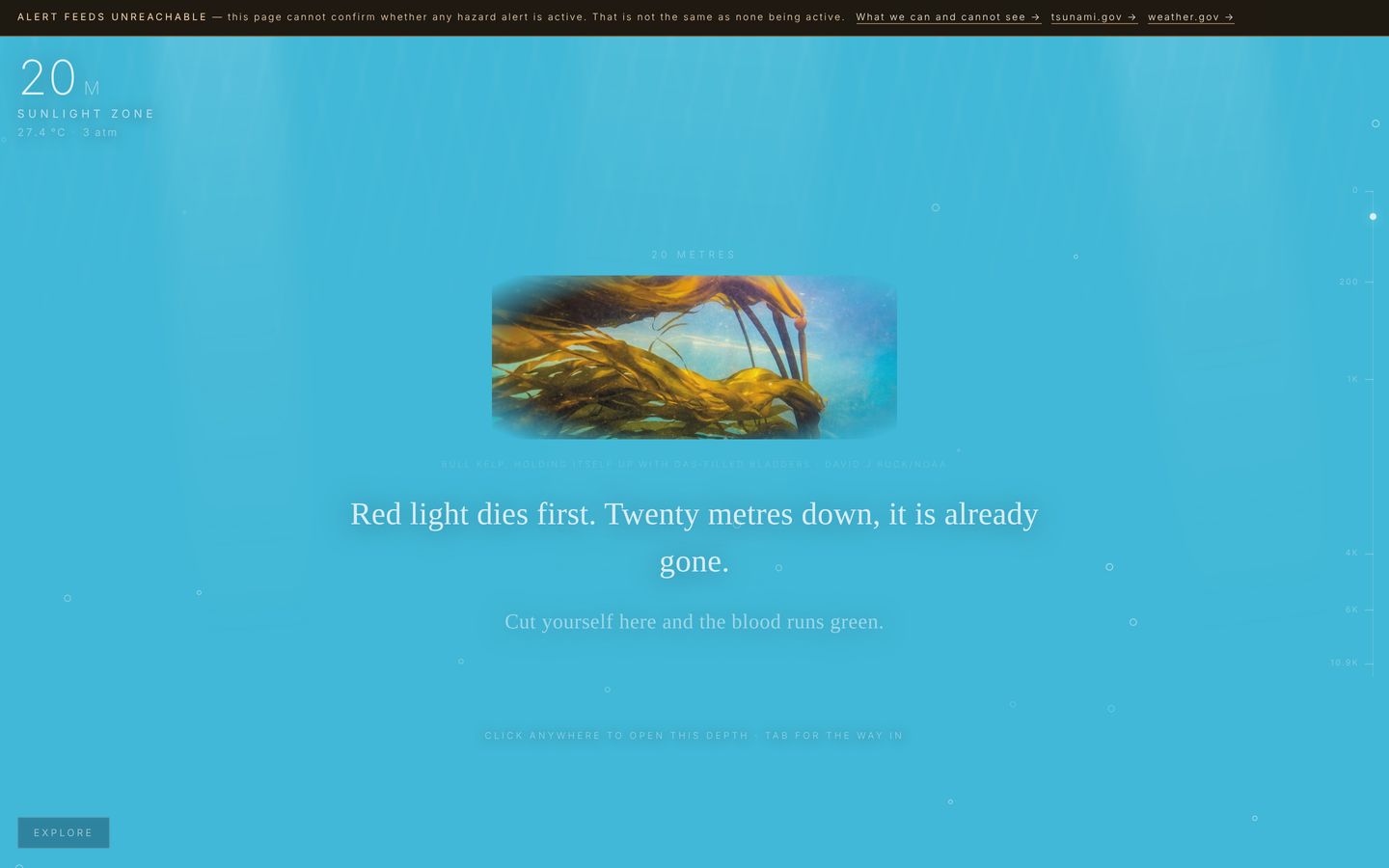
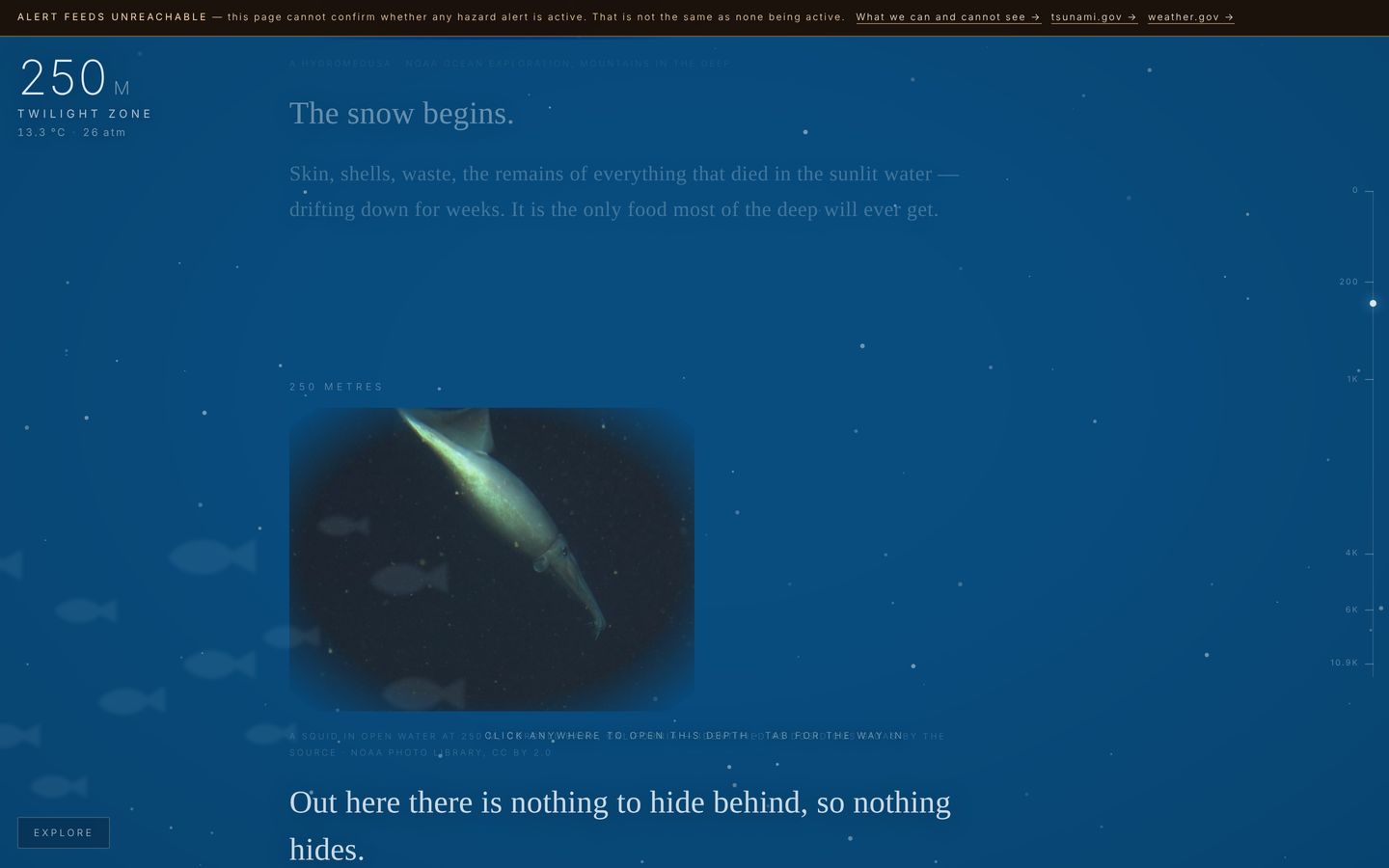
The Dive at 20 metresThe Dive at 250 metres

20 metres and 250 metres. The bar at the top is the live NWS marine alert feed.

The Dive

A scroll from the ocean's surface to the bottom of Challenger Deep, where every metre opens.

Click any depth and you get the pressure, the temperature, what lives there, what happened there, and the projects you can join or fund. Under the descent is a platform I built in 24 days because I couldn't stop: live marine alerts, a live globe, the trenches, an ocean history timeline, fisheries, a diver's path, surf, community uploads, careers and volunteering.

When
Aug 2026
Role
Own project, thediveproject.com
Stack
Python, Postgres, Docker Compose, magic-link auth
Size
268 commits, 92K lines
Proof
Verification gate; 0 of 480 facts unsourced at launch
Status
Offline; pictures rendered from the repo
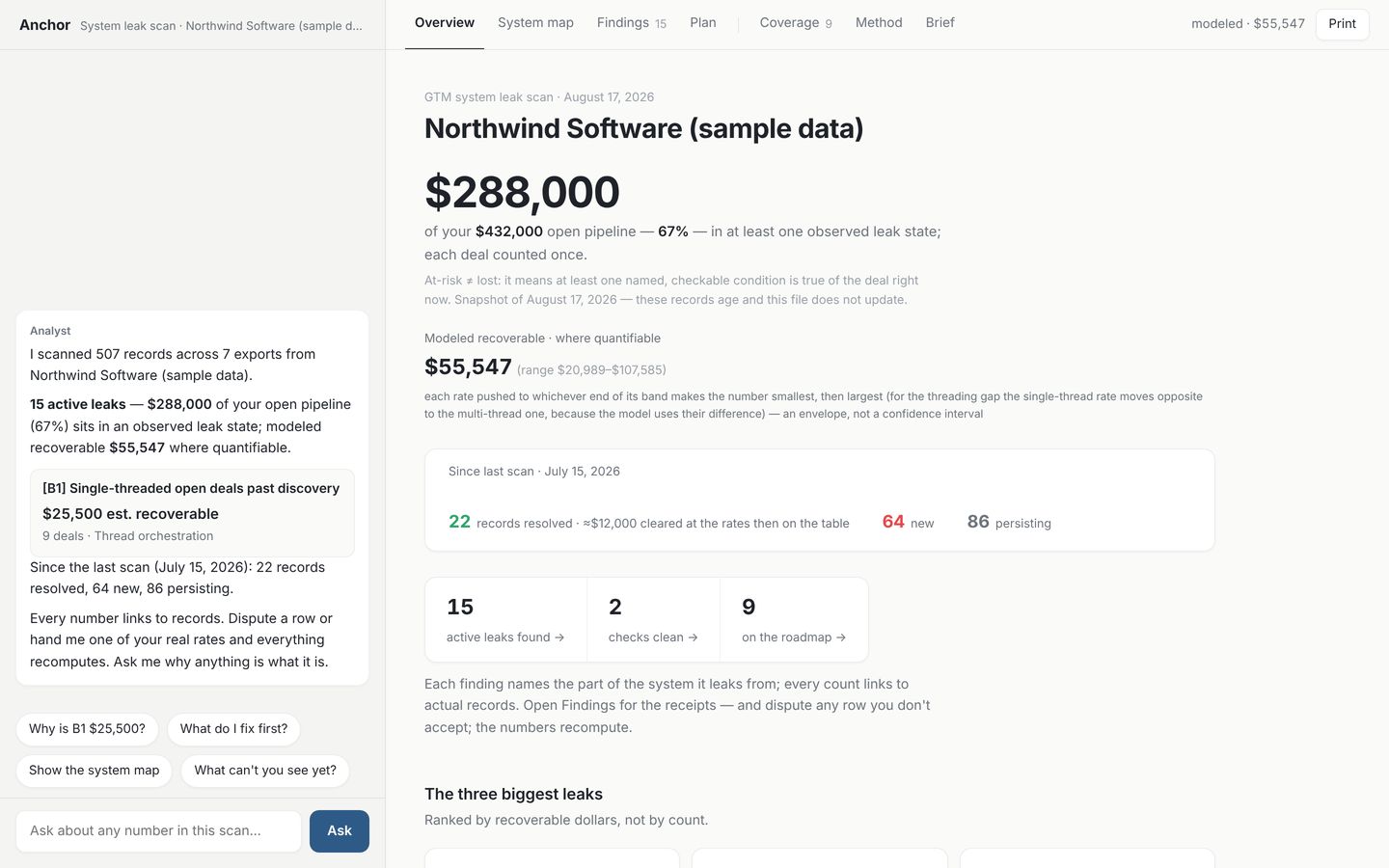
Anchor Scan report

The report on sample data. Dispute an evidence row and every number recomputes.

Anchor Scan

Finds where a sales team's revenue is leaking, prices it so a CFO can check the math, and hands over Monday's work queue.

Feed it CSV exports from the CRM, the sequencer, the calendar and the call recorder. It finds follow-ups that never happened, deals with one contact and intent nobody answered. The report is a chat with an analyst: tell it your real win rate and the whole model re-prices with your number labelled as yours.

When
Aug 2026
Role
Own project
Stack
Python, standard library only; Attio, Apollo, Fathom loaders
Size
17.7K lines, nine test suites
Proof
Validated on synthetic data with planted leaks, then a real export
Status
Working
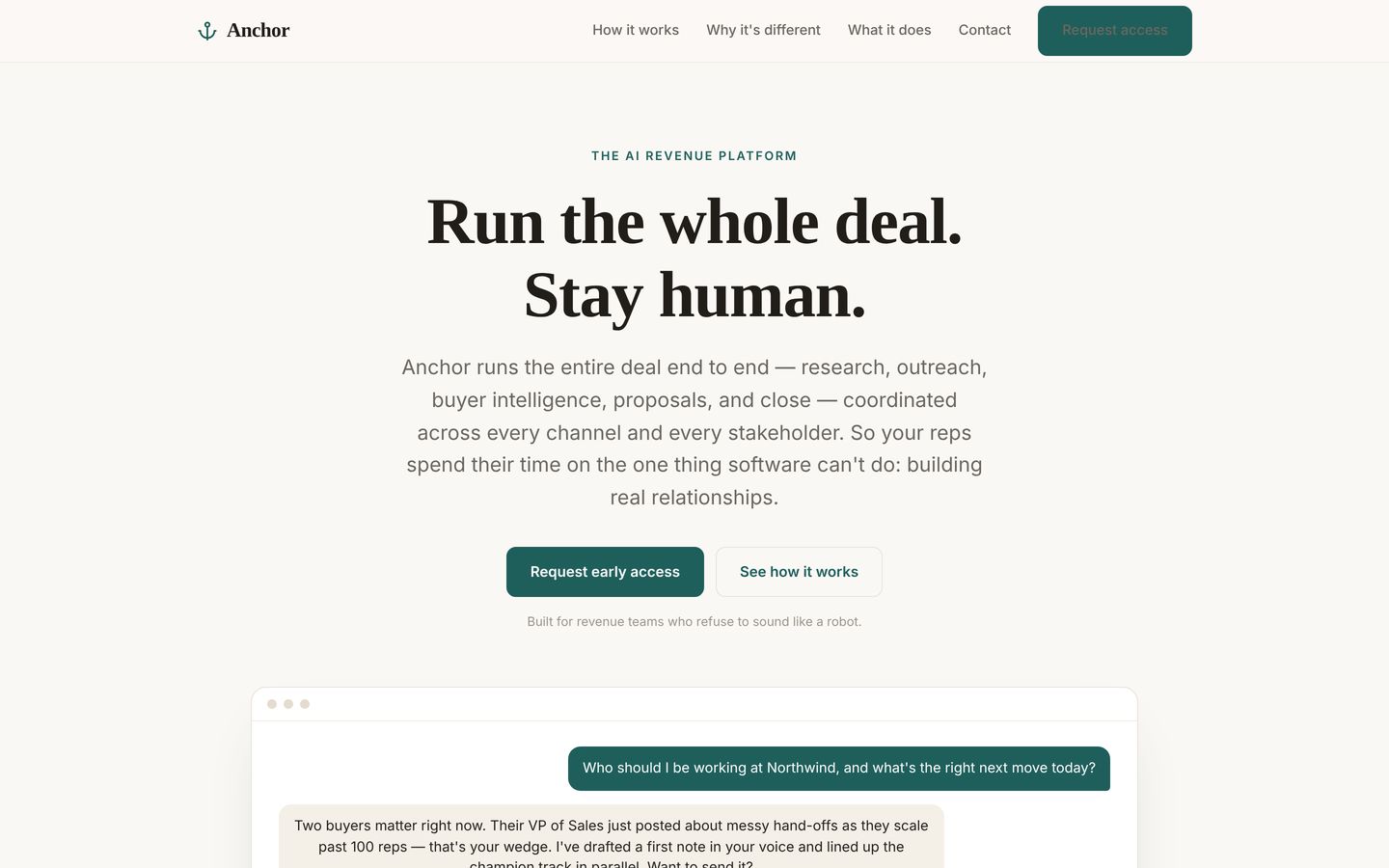
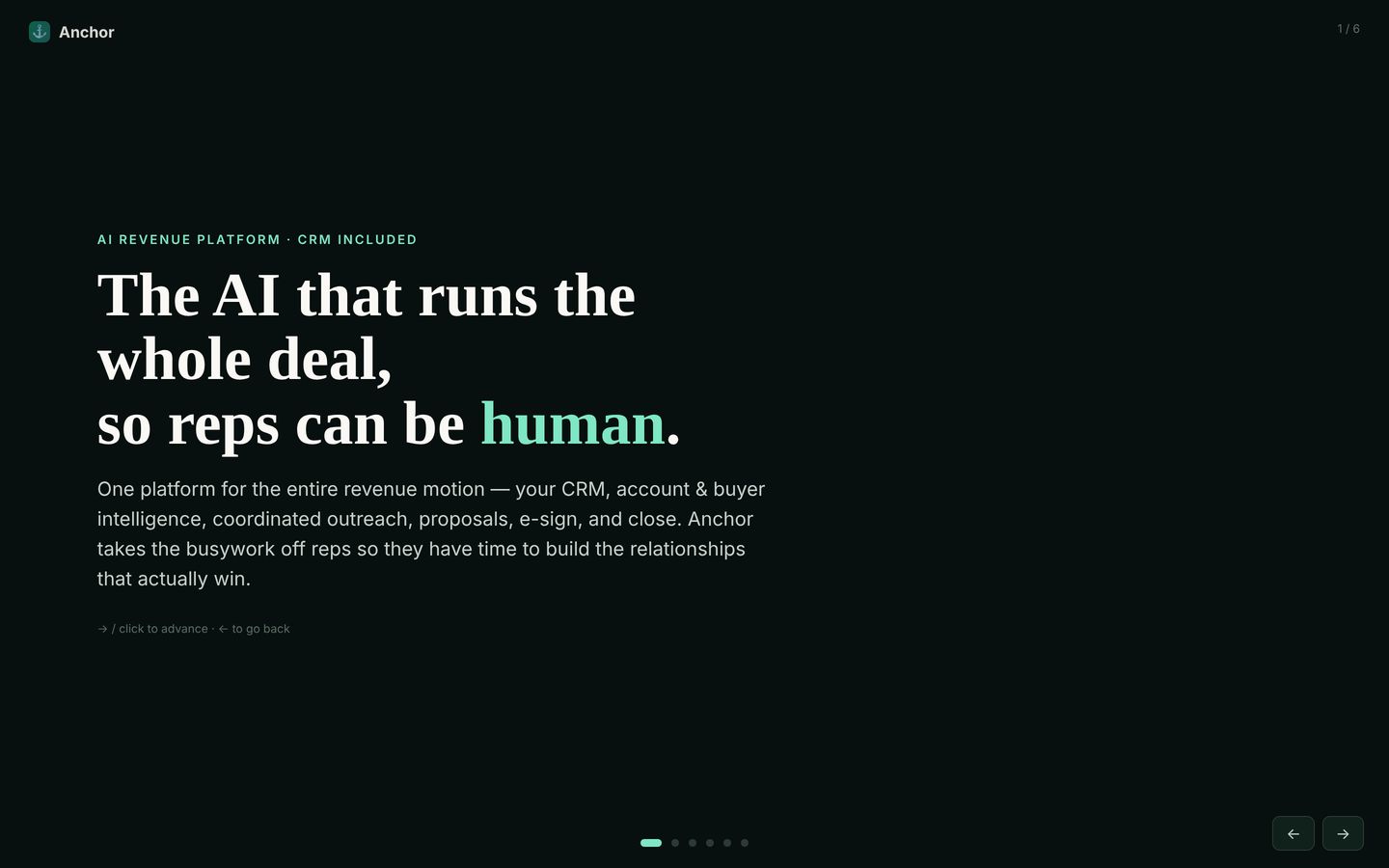
Anchor siteAnchor deck

The site and the deck. The app itself needs its backend to render, so it isn't pictured.

AnchorGTM

A CRM with an AI layer that researches buyers, plans outreach across channels, and drafts every touch in the rep's own voice.

Chat is the interface: "find me fifteen buyers at this account" or "draft the follow-up from today's call" happens inline, and a background worker has the day's plan ready before anyone sits down. I ran my own outbound on it every day for three months.

What broke, since that's the useful part: the web service was pinned to a frozen image tag, so for one session every web change silently never shipped while the worker did. The rule that came out of it, verify the running image digest after every promote, is in every pipeline I've built since. I retired Anchor because I came to think companies solve this in-house or buy it, and the later work follows from that.

Role
Own product, anchorgtm.ai
Stack
FastAPI, Postgres, Terraform, AWS ECS, GitHub Actions over OIDC
Size
1,475 commits, 287K lines
Pipeline
Docker locally, ECS staging, ECS production

On Record

Every AI LinkedIn tool is a writing tool pretending to be a strategist. This was the strategist.

It interviews you by voice to learn how you actually talk, sets content pillars, and measures whether a post did anything instead of counting likes. The data model is five primitives (a voice, whoever operates it, whoever pays, a campaign, the intelligence that comes back), so a solo founder, an exec with an EA and an agency running twenty clients are configurations, not code branches.

Sign-ups didn't come, so I paused it with a one-line switch that archives every job and deletes nothing. It worked; people didn't want it enough.

Role
Own product, onrecord.tech
Stack
Next.js, Supabase, Stripe, Inngest, Vercel, an MCP server
Size
995 commits, 383K lines
Proof
4,500 core tests, a canary, tenant rules enforced in the database
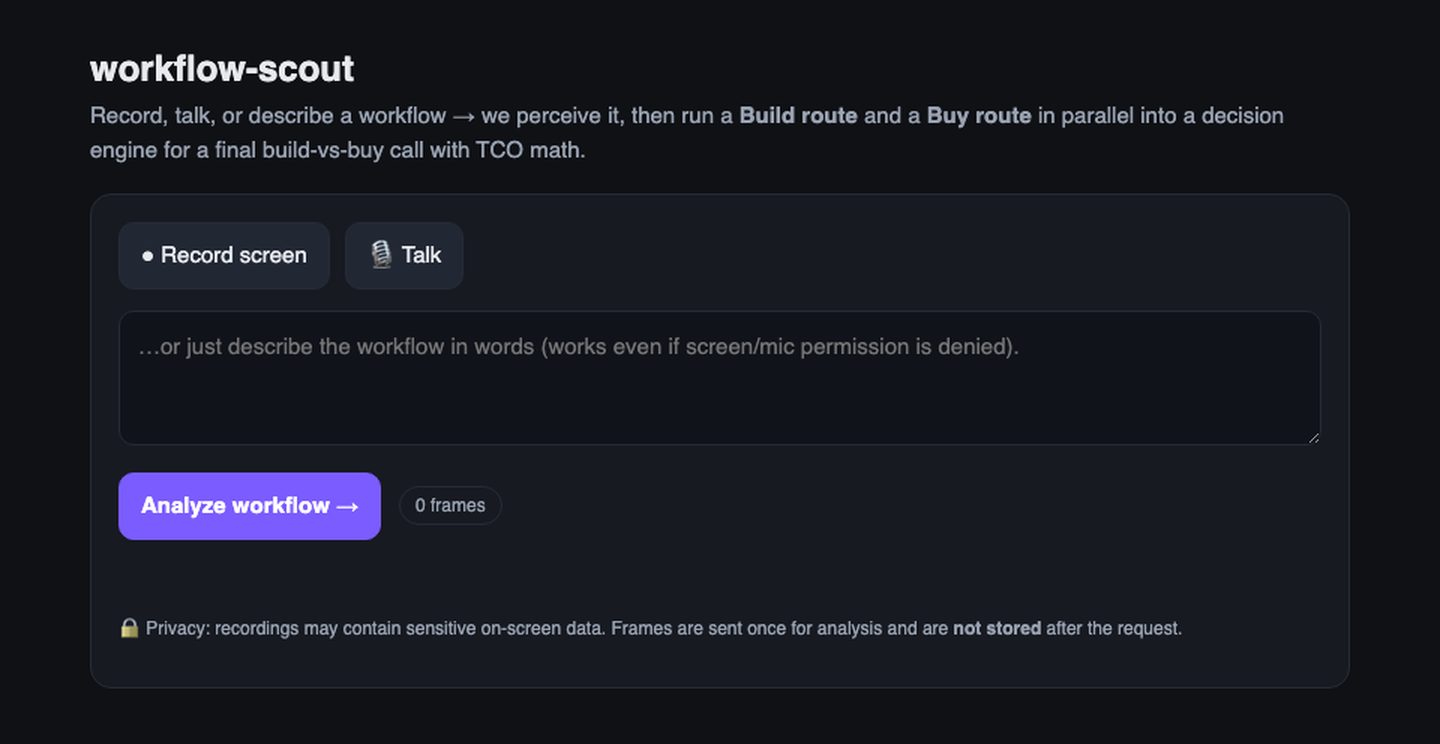
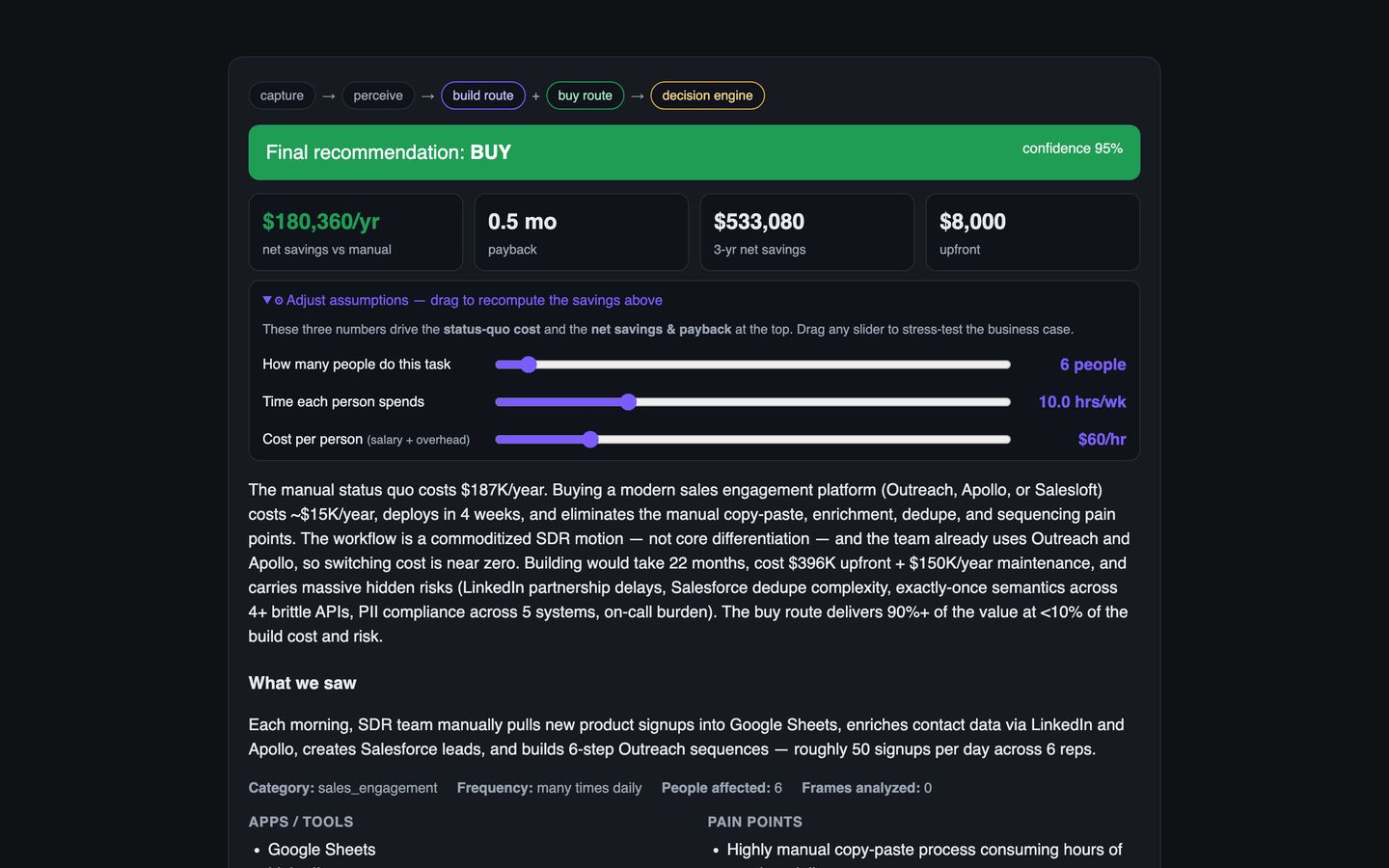
workflow-scout captureworkflow-scout report

workflow-scout

Record a workflow on screen and get a build-versus-buy answer with the economics behind it.

A multimodal model works out what you're doing, then a build route and a buy route run in parallel into a decision engine that returns vendors, a price, total cost of ownership and savings, with sliders you can drag. Capture stays in the browser; the server only sees sampled frames.

When
2026
Where
GMI Cloud AgentBox hackathon
Stack
FastAPI, asyncio branching graph
Status
Deployed as an AgentBox agent

Mobile app and the live voice interviewer · Jul 2026, AI content startup

Twenty-one screens of a LinkedIn content product's mobile app in Expo, built in eight days, plus a voice agent that interviews you out loud and turns the conversation into post angles in your own voice. Deepgram listens, Claude thinks, Aura speaks, all through my server so no key ships in the app. 14K lines.

The Availability Layer · Jul 2026

A scheduling engine between calendars and whoever needs time, built in a day. An agent calls one function and gets a real meeting; a person gets their week defended. TypeScript, 13K lines, vitest against stubbed calendars so CI needs no credentials, plus a live mode on Google Calendar.

Before this

Founding GTM at an AI-native LinkedIn content startup from mid-2025 to September 2026: $1.7M closed, including a $1M+ deal with a venture-backed wealth management firm across eight stakeholders and a paid pilot that converted, and the internal deal-monitoring agents (roughly 500K lines) that watched CRM, DocuSign and LinkedIn on every deal. Co-founded GTM Intel, acquired. Head of revenue at RevPal. AE and team lead at OneSignal, Doma and L&W Supply. I also lead the community team at RevGenius, which is about 60,000 revenue people.

Approach

The same loop every time, whether the customer is an enterprise HR team or me at six in the morning.

Discovery sets the spec

Calls, transcripts, and the customer's own system of record. The spec is a plain-English job description: who the agent acts as, what it may touch, what it refuses.

Guardrails in code

Prices, dates and permissions come from tools, never the model. Agents act as the signed-in person with their own token, so the system of record enforces access. Every action and refusal is logged with a trace.

Test with agents, then ship

Scripted passes against the real deployment, not a mock, through local, staging and production, with a canary and a kill switch. I say what was live-tested and what wasn't.

Secure from the first commit

CI deploys over OIDC so there is no stored cloud credential. Secrets live in AWS Secrets Manager or Workers secrets. Tenant walls are row-level security and triggers. Keys are bridged server-side so none reach a client. SOC 2 controls in mind throughout.

Tools, roughly by how much I use them: Claude Code and the Anthropic API, Cloudflare Workers with Durable Objects and D1, AWS with Terraform, FastAPI and Postgres, Supabase, Next.js, Expo, Twilio, Deepgram, Stripe, Inngest, GitHub Actions.

Contact

[email protected]